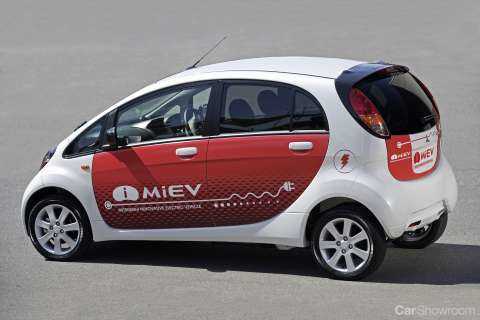
The future arrives at Mitsubishi Motors Corporation (MMC) in July 2009 when deliveries of the new EV i-MiEV electric car to corporate, governmental and local authorities commence. And from April 2010 this radical machine will be available to individual consumers.
Even a handful of years ago the prospect of a production-ready full electric car by 2010 looked improbable.
MMC chose World Environment Day, 5 June, as the perfect timing to unveil the production version of this keenly awaited vehicle. Having spent some four decades developing electric vehicle technology, MMC is well justified in making the claim that its EV i-MiEV is “the pioneer that will open the door to the next 100 years of our automobile society.”
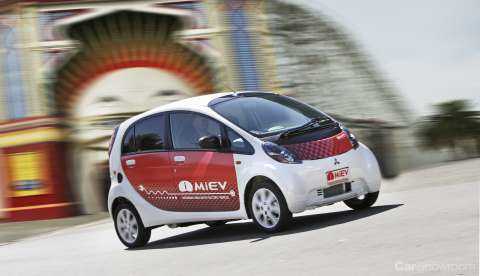
The company is presenting the production i-MiEV as the ultimate eco-car, a solution to the various challenges the automobile faces today including environmental pollution, global warming and the depletion of petroleum-based energy supplies. The company will continue its extensive collaboration with both private and public sectors in Japan and overseas in developing infrastructure to promote ownership of EVs.
Mitsubishi Motors expects to distribute, on a maintenance lease*3 basis, some 1,400 i-MiEV models in fiscal 2009 principally to corporations and to local authorities. The company plans to start sales of i-MiEV to individuals in April 2010 and will start taking orders in late July of this year.
*1 MiEV: Mitsubishi innovative Electric Vehicle
*2 i-MiEV: For the full production model a hyphen has been added to the name by which the advance experiment and proving models have been known.
*3 Maintenance lease: A lease in which the monthly payments include some of the taxes, insurance and maintenance costs.
i-MiEV : Overview
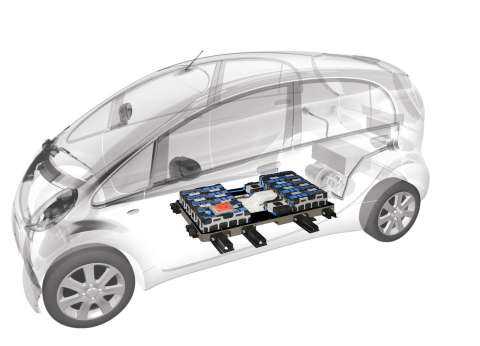
The i-MiEV makes maximum use of the long wheelbase that stems from its base model the 'i' minicar's rear-midship layout to install a large capacity lithium-ion drive battery under the floor and the power unit under the luggage compartment. This provides a cruising range that is ample for everyday use without compromising the generous seating or luggage space of the 'i.'
The introduction of the MiEV OS (MiEV Operating System)*4 - an advanced integrated vehicle management system into which the company has poured its wealth of know-how garnered from many years of EV research and development - has provided the kind of high performance and reliability that befits a new-generation EV.
*4 Generic name for the integrated vehicle management system developed by Mitsubishi Motors for new-generation EVs.
1. Principal product features
(1) Zero drive-time CO2 emissions
The i-MiEV is a zero-emissions vehicle (ZEV) which produces no CO2 emissions while being driven. Even when the CO2 gas emitted at power generating stations is taken into consideration, the i-MiEV generates approximately one-third of the CO2 produced by the gasoline 'i' minicar (Calculated in-house based on the average of electric energy frameworks in Japan).
(2) Driven 100% by electrical power
The i-MiEV is very economical because it only uses electrical energy as its power source. Also, depending on electric power company rate fees, the running cost can be reduced further by charging the battery when off-peak (late night) rates apply*5.
*5 An application must be submitted to the electric power company to qualify for domestic late night rates.
(3) Quiet, agile, comfortable performance
The i-MiEV delivers the quiet and comfortable motoring experience only possible from an internal combustion engine-less EV. Maximizing the excellent response and high low-end torque inherent to its electric motor i-MiEV enables a level of responsive and powerful performance that surpasses that of the gasoline-powered turbo engine 'i' minicar.
(4) Ample range for everyday minicar use
The i-MiEV has a single-charge range of 160 km*6 in the Japanese 10-15 mode urban driving pattern. This gives it a range that is ample*7 for everyday minicar use.
*6 Actual range will vary depending on weather conditions, road congestion and on how the driver operates his vehicle (use of accelerator, climate control system, etc.)
(5) 3 ways to charge the battery
The i-MiEV uses a 3-way charging system that allows the drive battery to be charged at home or when out and about. For normal charging i-MiEV is connected to either a standard 100-volt or 200-volt domestic outlet using the charging cables supplied with the vehicle. The i-MiEV's battery can also be 'quick charged' at quick-charge stations which are currently being established throughout Japan. Charging time guide *8
Method Power source Time
Normal** 200V AC(15Amp) Approx. 7 hours (full charge)
100V AC(15Amp) Approx. 14 hours (full charge)
Quick 200V 3-phase (50 kW) Approx. 30 mins. (80% charge)
*8 Actual charging times may vary depending on such factors as air temperature and power source status. ** The normal charging gun and normal charging connector were jointly developed by Toyota Motor Corporation and Yazaki Corporation.
2. Advanced technology
(1) Main powertrain components
a. Drive battery
The i-MiEV is powered by a very high energy-density lithium-ion battery manufactured by Lithium Energy Japan*9. The large-capacity drive battery is comprised of 88 lithium-ion cells connected in series and is installed under the floor in the center of the vehicle. This configuration contributes to outstanding handling and stability due to the car's low center of gravity.
*9 Joint venture established on December 12, 2007 between Mitsubishi Motors, GS Yuasa Corporation and Mitsubishi Corporation to develop, manufacture and sell large-capacity and high energy-density lithium-ion cells for EV use.
b. Motor (power unit)
The i-MiEV uses a high-efficiency compact and lightweight permanent magnet synchronous electric motor specially developed for the vehicle. It generates maximum torque from low engine speeds to deliver powerful response and a comfortable ride experience. When the vehicle slows down the regenerative brake system causes the motor to operate as a generator. The electrical energy recovered is stored in the drive battery.
c. Transmission
The i-MiEV uses a lightweight and compact single-speed reduction gear transmission, exploiting the high low-end torque inherent to the electric motor and eliminating the need for complex gear shifting mechanisms as found in internal combustion engine powered vehicles.
d. On-board charger
The i-MiEV comes with a compact, lightweight on-board charger that allows the drive battery to be charged using a domestic 100V/200V AC line.
e. DC/DC converter
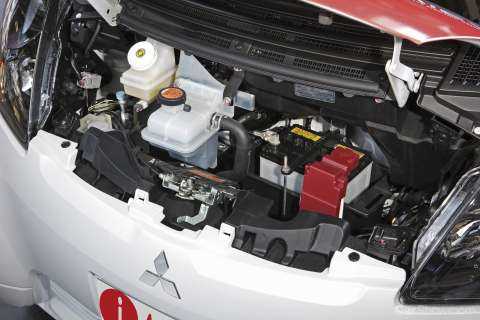
The DC/DC converter is used to charge the 12-volt auxiliary battery and power electrical equipment. It is integrated with the on-board charger in a single unit to reduce size and weight.
f. Inverter
The i-MiEV 's motor is driven by an alternating current. The inverter converts high-voltage direct current from the drive battery to alternating current and supplies motor with the power required to drive the vehicle.
*7 A nationwide survey in Japan indicates that on average 90% of car drivers cover less than 40 km/day on weekdays and that 80% cover less than 60 km/day at weekends and holidays (in-house research).