Not wishing to be too dramatic, but Car Showroom reckons Mercedes-Benz has nailed the future for motorized transportation – a long time before ‘stumps’ is called on internal combustion engines because we’re out of fuel. It’s hydrogen-fueled electric cars and we were one of a very small number allowed to drive one of the three multi-million-dollar prototype vehicles (called Mercedes-Benz F-CELL) currently circumnavigating the world in 125 days.
Why hydrogen/electric? Because the sources of hydrogen can be totally emissions-free and renewable – such as wind power and naturally re-growing algae.
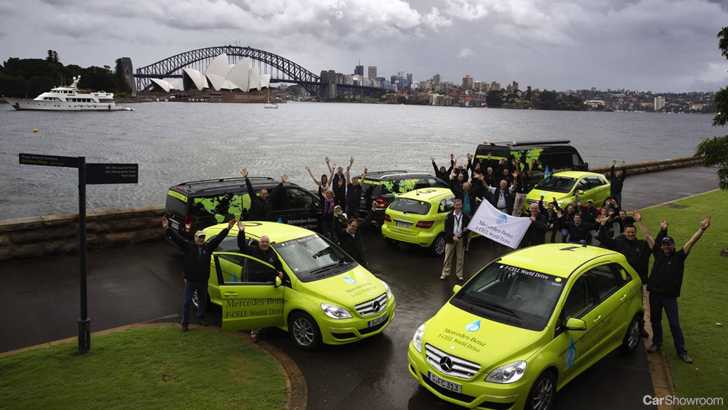
And even these first prototypes highlight why hydrogen-electric is superior to battery-electric. The Mercedes-Benz F-CELL we drove already boasts a range between hydrogen refills of more than 380-kilometres and refueling stops (like a stop at a conventional petrol station) take less than three minutes.
Three ‘Benz F-CELLs and their support vehicles are currently traveling around the world in 125 days to highlight the ‘right-now’ viability of hydrogen-fueled electric cars. They departed Benz’ headquarters in Stuttgart, Germany on 29 January and initially traveled west to the Portuguese port city of Lisbon for shipment to Fort Lauderdale, Florida.
From Florida, the trio of hydrogen-fuelled Mercedes’ traveled to the American West Coast and then headed north to Vancouver, Canada. The vehicles’ hydrogen fuel cell stacks are actually manufactured in Vancouver by Automotive Fuel Cell Corporation, a joint venture between Mercedes-Benz, Ford Motor Co and Ballard Power Systems.
Mercedes-Benz will commence mass production of hydrogen-fueled vehicles as early as 2015 and the plan is for all of the fuel cell stacks to be manufactured at the Vancouver plant and then shipped to wherever the vehicles will be produced (Germany, North America etc).
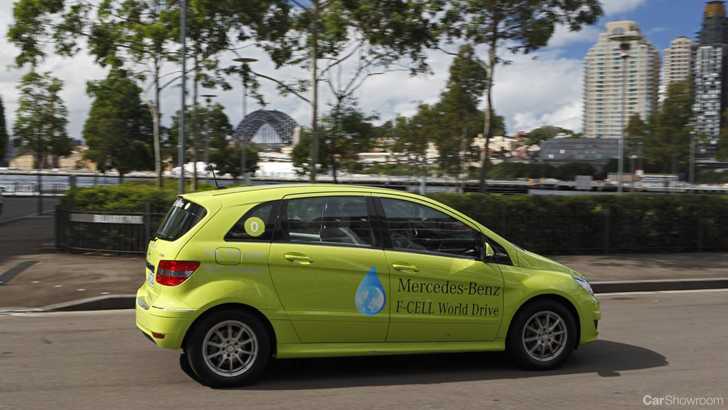
Some Mercedes-Benz F-CELL vehicles are already on-sale in Germany and the lease price is about $849 per month, including hydrogen (currently hydrogen sells for around €32-36 for a full tank).
From Vancouver, the F-CELLs crossed the Pacific to Sydney and then started the 5,000kms Australian section of their journey, stopping first in Melbourne, where Car Showroom slipped behind the wheel of one of the left-hand-drive, Stuttgart-registered super cars. Although immaculate - despite the 10,000kms covered in North America - we did think about ‘souvenireering’ a few grains of sand from around the pedals – they might have come from Fort Lauderdale beach in Florida you know!
The F-CELL is based on the Mercedes-Benz B-Class hatchback.
Mercedes-Benz says the hydrogen-electric fuel cell powertrain is 60-62-per-cent efficient – that’s three times more efficient than a diesel engine, but not as efficient as battery-electric cars which have one process less than the Fuel Cell vehicle. But of course: What about the environmental impact if the electrical power to recharge those batteries come from a ‘dirty’ source like brown coal (the predominant power station technology used in Australia)?
Hydrogen can be made from wind generation and algae, both of which are C02-free and of course the hydrogen-electric car is also zero-emissions.
Safety is another question often asked about hydrogen and naturally the immensely talented Mercedes-Benz engineers have comprehensively ticked that box as well. The F-CELL has already exceeded the requirements of all Government-mandated crash tests and – more significantly – met the more robust/higher standard/technically superior crash test standards set internally by Mercedes-Benz management.
For example, even though the Mercedes-Benz F-CELL hydrogen tanks operate at 700-bar pressure, they are safety rated to 1500-bar pressure.
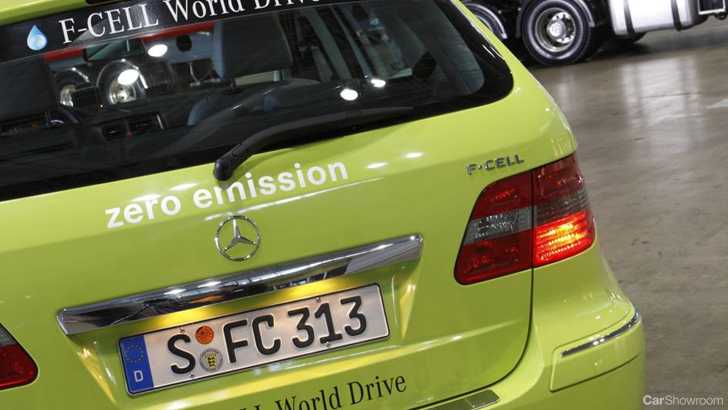
So we confidently climbed into the left-had side of the Mercedes-Benz F-CELL for our drive around Melbourne’s eastern suburbs. Essentially it’s a B-Class hatchback with power from an electric motor driving via the usual single reduction gear (no differential).
Unlike conventional battery-electric vehicles, the electrical power in the Mercedes-Benz F-CELL is generated on-board from a chemical reaction between oxygen and hydrogen. As a result, exhaust emissions are just water – over a range of 400kms, some 30-litres of water will trickle from the exhausts of the Mercedes-Benz F-CELL - and people who saw the cars driving in the early morning chill around Canberra reported steam coming from the exhausts (not a bad thing considering some alternatives).
Consumption is currently around 1.15kgs of hydrogen per 100kms of driving – corresponding to a diesel equivalent of less than 3.0kms/100kms.
The driving dynamics are predictably high-standard Mercedes-Benz. Ride and handling is the usual taut/form European standard and steering response is crisp.
Of course there is no engine noise so you do notice more wind noise around the exterior mirrors and A-pillars, plus some tyre noise which would be disguised in a conventional B-Class hatchback by the sounds of the 1.7-litre or 2.0-litre petrol engines or the 2.0-litre turbo-diesel.
Impressively, all of the hydrogen fuel and electric motor technology has been housed so that the Mercedes-Benz F-CELL delivers the interior and luggage space of the regular B-Class.
Mercedes-Benz says one of the major reasons for the F-CELL World Drive was to demonstrate the technical maturity and suitability of electric vehicles fueled by hydrogen fuel cells.
Of course – like recharging points for battery-electric vehicles – that technical maturity will never reach full market potential without a comprehensive hydrogen refueling infrastructure. Enter Germany’s Linde Group and its Australian subsidiary BOC Gases.
They combined to provide hydrogen re-fueling for the F- CELL World Drive. BOC is a company with 3,000 employees in Australia, turning-over $13-billion annually and has been working with hydrogen locally for more than 100 years.
BOC says technology for hydrogen production is mature and very standardized and the quality of the hydrogen it produces (currently only at its plant in Altona, Melbourne) is also very standardized. This is a clear contrast to the volatile standards of unleaded gasoline and diesel we notice in Australia which leads to smelly exhausts and mechanical problems in our engines.
Typically for Mercedes-Benz, the technology involved in the F-CELL is mind-numbingly complex and every bit as impressive as the McLaren-Mercedes-Benz Formula One car which raced at Albert Park just a few days before we drove the hydrogen hatchback in suburban Melbourne.
But for Mercedes-Benz customers, the result is astonishingly simple – the F-CELL offers the everyday convenience, safety, driveability and operating ease of the current B-Class hatch. And it’s these ‘same-old-same-old’, real world, run-of-the-mill operations which make the hydrogen-electric Mercedes-Benz F-CELL so very, very significant for the world’s motoring future.
It’s the fact that customers already driving the F-CELL in the Northern Hemisphere report it’s just like a normal car, which makes the F-CELL so successful and one of the most significant achievements for Mercedes-Benz, – a company which has probably racked-up more significant achievements than any other company in the history of the motor car.


