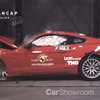
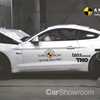
Mustang’s poor showing in NCAP testing leaves many wanting.
The Ford Mustang, the best-selling sports car in Australia, has thus far managed over 6,000 sales since its introduction. Outdoing its next sales rival threefold, it would have been a surprise to interested parties that the Mustang had never been crash tested here in Australia or by any accredited New Car Assessment Program (NCAP) body in the world.
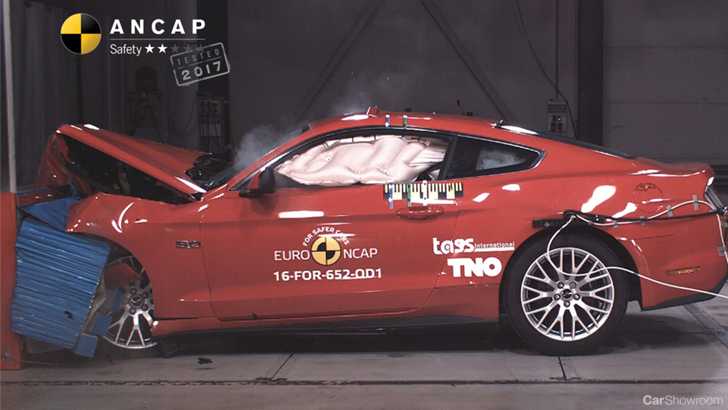
Until now. Following tests conducted by EuroNCAP, the Australian safety regulators have awarded (if we can say that) Ford’s famous pony car with just two-stars, one of the lowest ratings in Australian NCAP history. Both Ford and ANCAP are quick to point out that these results come in after a raft of regulation-tightening measures have come into effect, making NCAP stars more difficult to obtain now than ever before.
While the Mustang scored a 4-star equivalent for adult occupant safety, it only managed 32% for child occupant protection and a disheartening 16% for active safety features. The lack of active safety tech in particular detracted immensely from the Mustang’s overall safety score. James Goodwin, CEO of ANCAP, said that the results were “simply shocking for such a newly-designed and popular model.”
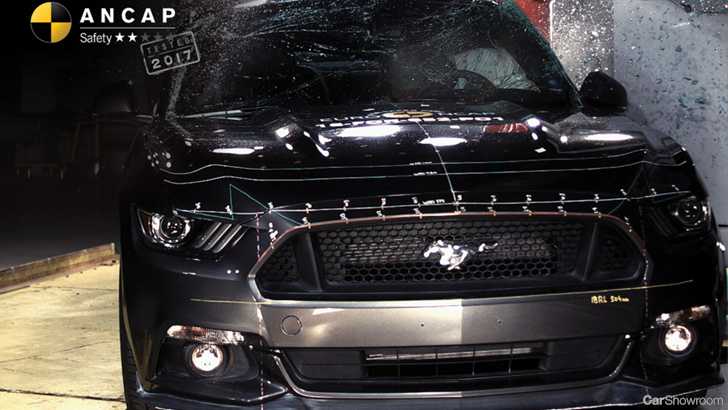
“The safety of adult occupants, child occupants and the ability to avoid a crash all form the basis of our ratings and the Mustang falls short in each of these areas,” he commented. Goodwin then went on to criticise the Mustang’s lack of active safety features, with things like autonomous emergency braking, lane keep assistance, collision warning and even rear seat belt reminders lacking from this premium sports car (but available in cars much, much lower down the food chain).
The ANCAP CEO also noted that while the Mustang offered average structural strength, some of the safety features it does come with did not perform quite as intended. “There was insufficient inflation of both the driver and front passenger airbags during the frontal-offset test,” he said, “which allowed the driver’s head to contact the steering wheel and the passenger’s head to contact the dashboard.” Worryingly still, the driver’s door actually opened during the pole-impact test.
“This rating is not intended to shock or surprise,” Goodwin reassured. “We maintain strong relationships with vehicle brands,” he said, going on to say that Ford had been kept informed during the duration of testing.
Ford Australia has not been quiet, though. In response to ANCAP’s report, external communications boss Martin Günsberg immediately reminded observers that the Mustang garnered a ‘Good’ rating from the IIHS, and a five-star safety rating from NHTSA, two safety regulating bodies in the United States. “The overall Euro NCAP rating is based on four pillars (Adult Occupant Protection, Child Occupant Protection, Pedestrian Protection and Safety Assist), with a very strong focus on family car and SUV safety characteristics and specific safety assist features, which are usually not part of the standard equipment of cars in the Mustang category,” he said.
And while Günsberg tried to excuse the Mustang’s poor safety performance, he did mention that the 2018 Mustang will come with driver assistance features (like AEB, lane keeping aid, and maybe blind spot monitoring) along with its revised new look. Will this effect the long waiting list for the Mustang? Time will tell.
For more information on Ford, check out our Showroom.