Zero Pollution Motoring Needs Infrastructure
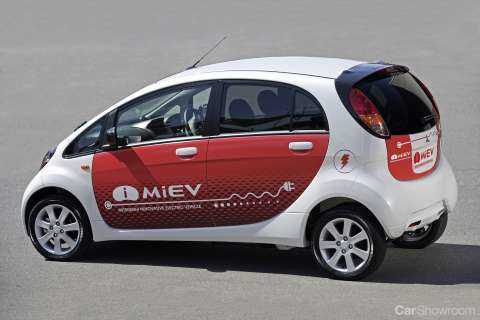
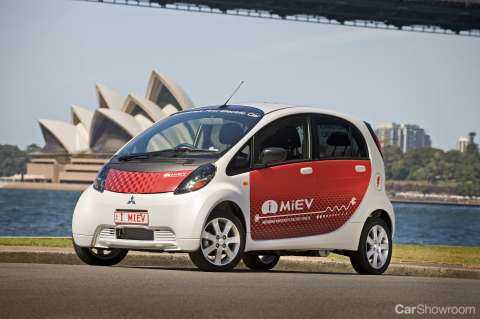
Car Showroom was part of a select few to drive the future of motoring – the Mitsubishi i-MiEV electric vehicle.
The first electric vehicle fully certified and homologated for volume sales in Australia, the i-MiEV (or Innovative Electric Vehicle) toured the East Coast as Mitsubishi demonstrated its capabilities to the media, dealers, major fleet companies, State and Federal
Government and energy companies.
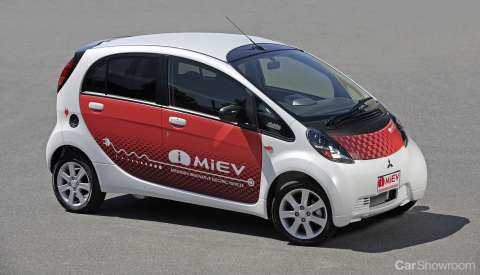
Mitsubishi will launch the I-MiEV onto the Japanese domestic market in June ahead of planned launches in Europe and North America. Mitsubishi Australia would like to follow very soon, but much work needs to be done (but not on the car - it’s finished, tested, ready and going into production now).
While the Australian media, dealers and customers are important, unless Mitsubishi gets buy-in from critical stakeholders in State and Federal Government departments as well as the energy providers, the electric car concept will stall indefinitely.
Crucially, as a nation, we cannot let that happen.
Here are a few quick myth-busting facts to get things started:
- the world’s oil reserves are finite
- the majority of Australians live in major capital cities – most drive less than 100kms per day and many actually drive less than 50 kms per day
- the Mitsubishi i-MiEV has a range of more than 160 kms
- the cost to re-charge the Mitsubishi i-MiEV from empty to full is approximately four cents
- if every car currently on the roads of NSW and the ACT switched to electric cars this second and they all plugged-in simultaneously tonight to re-charge, the existing electricity grid could easily cope with the demand – which is about the same power used by households in those states on a cold winter night
However there is no denying the co-operation of Government and energy providers is vital because some major infrastructure is needed in order to make everyday electric vehicle motoring practical.
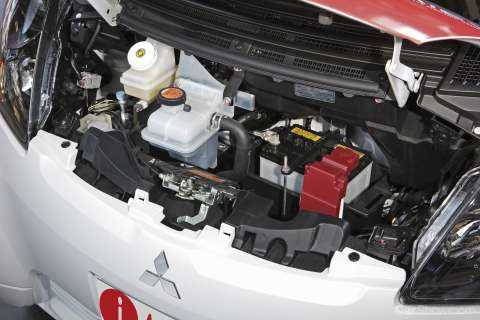
Principally that means re-charging points for electric cars in major capital cities.
Take London and Paris as examples. They already have a number of quick-charge points to re-charge electric vehicles and because of the low cost involved, local governments simply pick-up the tab.
Given that the majority of Parisians and Londoners do not have home garages, they rely on those re-charge points to keep their electric vehicles on the road. Here, more than 80 per cent of us garage our cars at night, so Australia does not need electric car infrastructure to the same extent as European cities.
So what is the i-MiEV like to drive? Is it a viable alternative to gasoline or hybrid vehicles?
It drives very impressively and would make a perfect commuter car for the vast majority of Australian private, family and commercial motorists.
The major breakthrough that makes the i-MiEV an everyday consideration is Lithium-Ion (LI) batteries.
This new battery technology is small, lightweight, is quick to re-charge and offers a long lifetime. Crucially LI batteries do not have ‘memories’ so unlike the old model mobile phone batteries we used to curse, you can drive you car just a few kilometers and plug it in again for a charge top-up without requiring the battery to be fully drained.
In order to control the production of batteries for the i-MiEV and other future electric vehicles, Mitsubishi has partnered with battery company GS Yuasa to establish a new joint venture company and battery assembly plant in Japan.
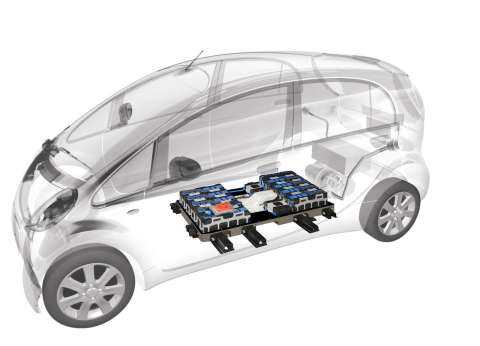
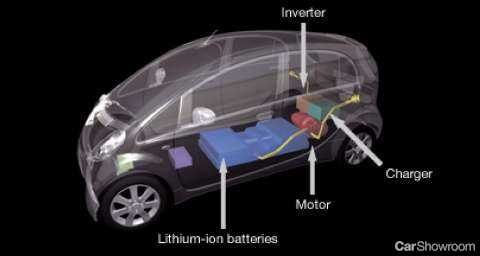
In the i-MiEV, the 88 batteries (grouped in modules of four) are so compact they’re placed under the floor. The, motor, inverter and charger are mounted under the boot.
The result is a small hatchback which can accommodate four adults and luggage in much the same way as the current petrol-engined Mitsubishi Colt, Toyota Yaris, Honds Jazz etc.
Power is 47kW and peak torque is 182Nm. With the nature of electric engines and with no clutch, that torque is available from zero so the i-MiEV departs rapidly from stationary.
The i-MiEV has three speeds – ‘Drive’ ‘Eco’ and ‘Brake’. Drive is just like selecting Drive in a conventional automatic. ‘Eco’ delivers less power (for example in stop-start city traffic this would be ideal). ‘Brake’ delivers high regenerative braking to slow you down on prolonged downhill sections where it would not be wise to ride the brake pedal that long.
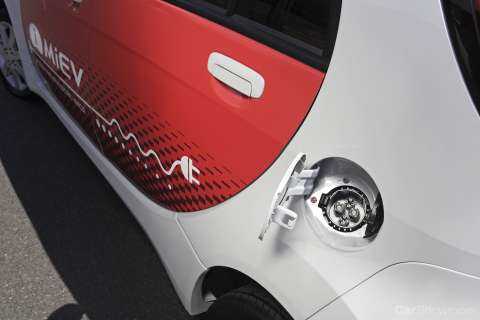
i-MiEV’s dashboard is just like a conventional dashboard, it comes equipped with air-conditioning, power windows, power steering and a modern audio system…just like a conventional car.
So you climb-in, fasten your seat belt, push the start button (it’s all quiet at this stage) then you select ‘Drive’ or ‘Eco’, press the accelerator and the i-MiEV takes off – very rapidly if you ‘floor’ the accelerator. As you gain speed, some noise is heard – wind-noise around the A-pillars and some road noise from the tyres.
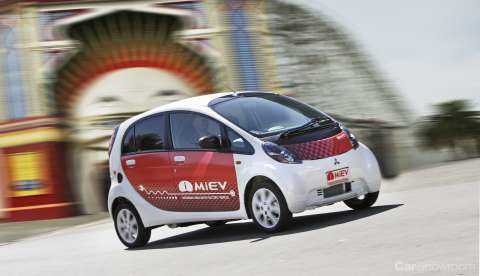
Car Showroom drove the i-MiEV around the Albert Park F1 Grand Prix circuit and in no time, we had to slow for one of the tight, right-angle turns. This is where you do notice a change – electric cars have no engine braking so you do work the brakes a little harder to slow or stop the car.
In a related way, with no gearbox or clutch, Mitsubishi engineers introduced a small amount of ‘creep’ into the i-MiEV driveline so you can crawl along in peak-hour traffic (like idling in a conventional car) and also you can depart from standstill with the neck-straining jerk sometimes encountered with golf carts and more primitive forms of electric vehicles.
Mitsubishi says the i-MiEV has a top speed (governed) of 130 km/h.
The time to charge the i-MiEV from a conventional 240V power point is seven hours. In everyday use, you would arrive home from work, university or wherever, plug-in your i-MiEV, walk into your house and plug-in your mobile phone and laptop and the next morning they’re all re-charged and ready to go again.
It’s this everyday routine that makes i-MiEV so practical – you just get used to the process in the same way we have with mobiles and laptops.
Mitsubishi Australia cannot determine the likely retail price of i-MiEV as currently there are too many unresolved variables. In Japan it will carry a price premium over equivalent petrol models, but in that market, subsidies to encourage buyers to be early adopters will cut almost 75 per cent of that price premium.
“Our Federal Government has certainly talked a lot about green vehicles so we hope they too will provide financial incentives for Australian motorists to be early adopters and buy the i-MiEV,” explained Mitsubishi Australia’s CEO Robert McInirey.
Numbers of cars at launch might be a hurdle even for Mr McInirey’s undoubted enthusiasm for the i-MiEV.
Mitsubishi and GS Yuasa are still getting production of the LI batteries up to speed at their new joint-venture plant. How quickly they can supply batteries in large quantities will determine the launch timings for the i-MiEV in Australia.
It seems electric and hybrid vehicles are the future of motoring. Car Showroom has now driven both and we have great confidence in the prospects of driving great cars for a long, long time.


