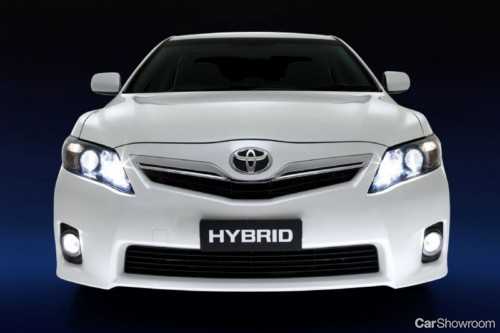
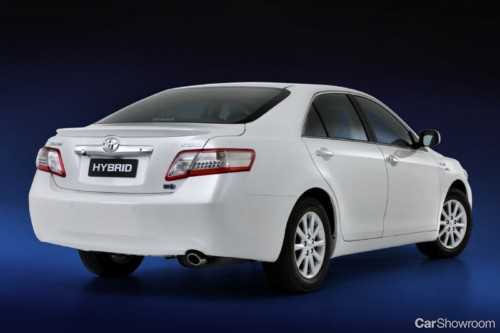
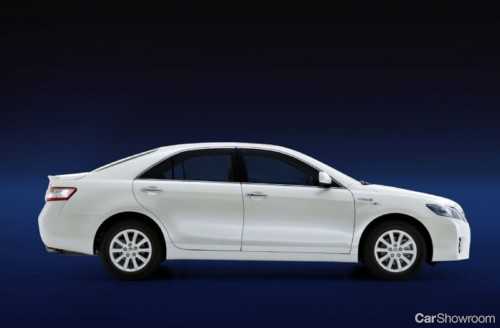
Toyota's Australian-made Hybrid Camry will be instantly recognizable from conventional Camrys.
And the changes are not just for the sake of appearances - Hybrid Camrys offer enhanced aerodynamics designed to reduce both their fuel consumption and wind noise.
In fact interior quietness has been a big challenge for Toyota's designers and engineers.
'You're always chasing noises in cars but this car is extremely quiet when running only on battery power and that in-turn lead us to improve noise suppression in other areas,' explained Paul Beranger, Corporate Manager of Toyota Style Australia.
When work on the styling for the Hybrid Camry commenced three years ago, the brief for Beranger's team was complex. Research showed Hybrid Camry buyers would be a mixture of existing Camry owners trading up and 'Early Adopters' buying into the concept of a hybrid-powered conventional sedan.
'People want to say 'I'm driving a Hybrid' but they also want the conventional Camry sedan design values,' Mr Beranger revealed.
The final result, which goes in sale in February, is a credit to the Toyota Style Australia efforts.
At the front, Hybrid Camry clearly shows the DNA of Toyota's Prius Hybrid with blue tint headlights, a slim upper grille and a large lower air intake - all finished in satin chrome. The large lower air intake is necessary to direct cooling air into the section of the engine bay which accommodates the hybrid power components.
The unique front bumper is also reminiscent of the Prius with sharp outer edges and flat sides to direct air flow down the sides of the car. These changes combine with aerodynamic covers under the engine, rear floor and fuel tank to reduce the drag co-efficient to 0.27 - the lowest of any locally-produced vehicle.
At the rear, LED tail lights with clear lenses distinguish Hybrid Camrys from their conventional stable mates.
Inside the trunk, the battery pack sits between the rear wheels (to improve weight distribution) and this has slightly reduced the boot capacity to 389 litres - Toyota says this still easily accommodates four large suitcases or four full-size sets of golf bags. The 60:40 split rear seat remains although the size of the 'through-slot' is slightly smaller - but still able to fit snow skis and some surfboards.
Elsewhere, the dashboard has some changes - including s blue tint (part of Toyota's Hybrid DNA) and of course the energy flow screen which - like the Prius - shows which form of propulsion is being used and the fuel consumption.
David Buttner, Toyota Australia's senior executive director, sales & marketing, told Car Showroom that local research shows Australians know that Toyota is best-equipped to build Australia's first hybrid vehicle. 'Toyota is leading the hybrid agenda, there's no doubt about that and in fact our research shows 38 per cent of people now know what HSD (Hybrid Synergy Drive) is and this is a far cry from just a few years ago,' Mr Buttner said.
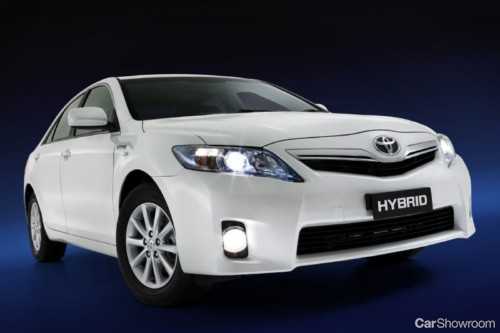
And it is for those reasons it was important for the Camry to share some design styling cues with the Prius. 'It was important that the Hybrid Camry has the same 'face' as the Prius (blue-tint headlights, upper and lower grille sections etc) because consumers see the Prius as the Hybrid leader,' explained Peter Hutchinson, Senior Designer at Toyota Style Australia.
The Hybrid Camry is now in full-scale production at Toyota' s Altona, VIC plant and goes on sale in February. Currently the petrol Camry is the most fuel-efficient car produced in Australia, consuming just 8.8l/100kms and Toyota insiders reckon the Hybrid Camry could use around 30 per cent less.


