New ‘Global Architecture’ means they can unleash their engineering geekiness.
Japanese automotive powerhouse Toyota has detailed its very latest engineering breakthroughs, making full use of the Toyota New Global Architecture (TNGA) platform that can accommodate new engines, drivetrains, and various other technologies. TNGA is expected to be used very, very liberally across Toyota’s lineup, with the new powertrain units expected to find their way into approximately 80% of new Toyota and Lexus vehicles within the next 5-years.
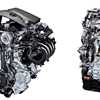
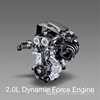
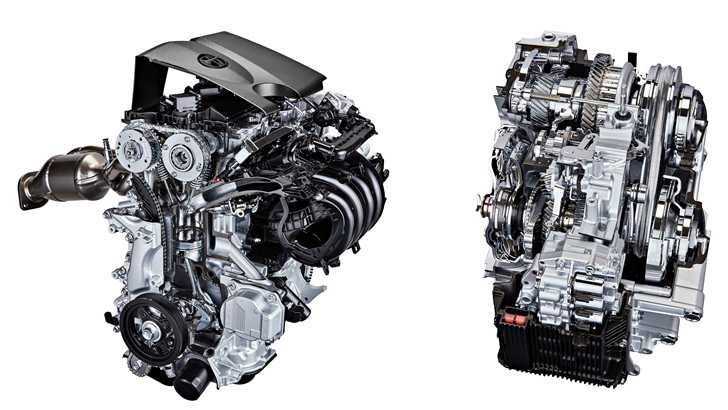
We’ll start with the new 2.0-litre Dynamic Force mill. The four-cylinder naturally-aspirated petrol mill joins the 2.5-litre unit that debuted with the new Camry, and boasts an impressive 40% thermal efficiency in pure-ICE configuration, with thermal efficiency going up to 41% in hybrid applications. Variable valve timing and both port- and direct-fuel injection means that the new mill is capable of offering better efficiency and more power as and when needed.
On its own, the new 2.0-litre Dynamic Force unit can put out 126kW and 205Nm, while in hybrid applications, the engine will produce a slightly lower 106kW and 180Nm (leaving room for the electric motor to chime in and further improve fuel efficiency).
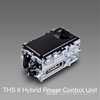
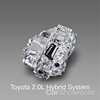
On to that hybrid system. The new 2.0-litre Dynamic Force mill will be mated to a new Toyota Hybrid System (called THS II), which will be first utilised by the upcoming Corolla hatch. Toyota claims that the new powertrain configuration is a clear step up from the 1.8-litre hybrid system presently employed, though there’s no mention of power outputs (or indeed fuel consumption figures) .
The new 2.0-litre hybrid setup utilises a reworked power-control unit that is more efficiently packaged, allowing for it to be situated directly above the motor-generator transaxle. That transaxle is also where the new synchronous AC motor lives, utilising a new rolling-coil structure in its design that utilises far fewer wires than before, as well as a newly-developed magnetic steel. The electric motor now has a maximum output of 80kW and 202Nm, with power being supplied by a new nickel-hydride battery, which is smaller and lighter thanks to more efficient packaging.
Toyota has also developed a new CVT automatic transmission. Dubbed ‘DirectShift,’ the new CVT utilises a launch gear to reduce the ‘lag’ that most people feel CVTs suffer from, which Toyota claims has never been done before. When setting off from a stop, the transmission system uses that launch gear, improving responsiveness. Once on the move, a new vane pump moves drive from that gear to the CVT belt. Together, it improves the range of gears offered by the CVT further improving efficiency. And on top of that, the utilisation of a launch gear has resulted in a reduced input load, which in turn results in the adoption of smaller components for the pulleys and belts.
Toyota claims that the new DirectShift CVT offers performance that is on par with or superior to firms that offer double-clutch transmissions, while besting their fuel efficiency by as much as 6%. They haven’t left the manual transmission out in the cold, though: They’ve also developed a new six-speed manual transmission, that is some 7kg lighter, 24m shorter, and has iMT features which, most notably, is capable of rev-matching upshifts and downshifts for smoother changes.
We’re not done yet.
Toyota has also introduced two new all-wheel drive systems that will be utilised by TNGA. The first is called ‘Dynamic Torque Vectoring AWD’ which will be put to use by the pure internal-combustion setups. DTV-AWD permits torque to be moved from the left to right rear wheels based on driving conditions.
And for the all-wheel drive hybrids, there is a new system called E-Four, which has been optimised for models that utilise a rear-mounted motor to drive the rear-wheels. With E-Four, total torque that can be offered by the rear wheels has been upped to 30% (of total system output, whatever that might be), while a new brain for the system optimally distributes torque between the rear wheels based on prevailing conditions. E-Four and DTV-AWD are a part of the three new all-wheel drive systems (with eight variations between them) that Toyota intends to utilise in its passenger and commercial vehicles.
For more information on Toyota, check out our Showroom.