Complete with local components, two examples of Nissan’s ground-breaking LEAF electric-powered hatchback have arrived ‘Downunder’ ahead of next year’s full-blown trial of 16 vehicles by the Victorian Government.
The Nissan LEAF stands-out among current electric vehicles because it’s…well it’s big. While Mitsubishi’s much talked-about i-MIEV is a compact car, the handsome Nissan LEAF is larger than conventional rivals Mazda3 and Toyota Corolla, meaning handy interior space, despite the storage of its lithium-ion batteries under the seats.
Now, after this real-life acquaintance with the LEAF, Car Showroom reckons this everyday convenience makes Nissan’s newcomer the most compelling electric car yet. For example the boot is enormous – 300-litres which Nissan says can accommodate two golf bags without folding the rear seat.
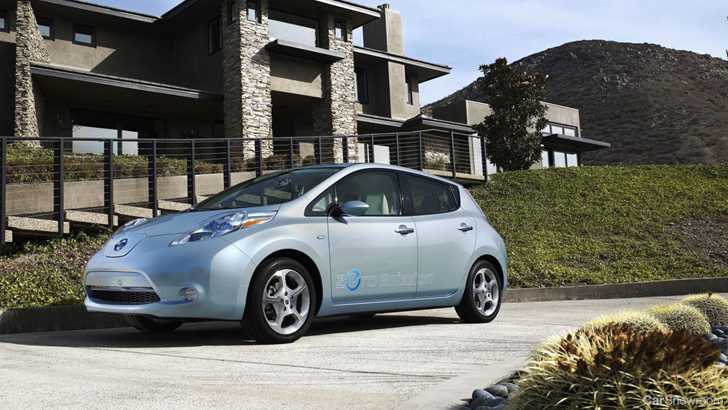
Nissan showcased the two LEAFs at its Dandenong, Victoria aluminium casting plant which has won a lucrative international contract to supply cast inverter cases, water jackets and water jacket covers for LEAFs which will be manufactured in Japan, England and North America. Under the $169-million deal, Nissan Casting Australia will also supply a fourth - as yet un-named - component for the LEAF from a later date.
While the LEAF is already on-sale in Japan, Nissan Australia – like Mitsubishi with the iMIEV – is grappling with considerable red-tape and logistics issues ahead of planned local introduction within the next 12 months.
Providing charge for the lithium-ion batteries is the obvious challenge, with several providers developing appropriate systems. At Nissan’s Dandenong (Victoria), Head Office, ChargePoint, had one of its home and commercial charge stations on display (the home unit bills directly to your energy account, while the commercial one requires swiping of a credit card).
Lance Douglas, ChargePoint’s technology chief, told Car Showroom the system is a ‘smart’ one capable of communicating directly with the car it is recharging. On the Nissan LEAF, the recharging point is cleverly located at the front, behind the Nissan badge on a panel which folds down.
Mr Douglas had extra good new for Nissan LEAF buyers – his company’s ‘smart’ system may allow them to ‘sell’ excess electricity back to the power grid. In extreme emergencies where power is out, Nissan LEAF owners could, for example, band together to supply electric energy back to the power grid to keep a hospital functioning until normal electricity is returned.
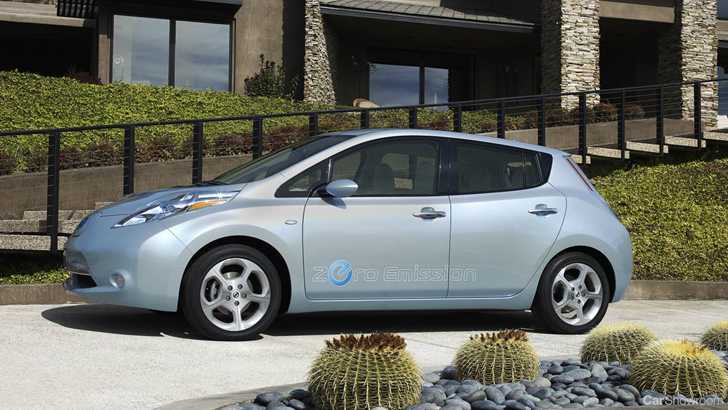
Then there is the issue of range between recharges. The LEAF has an ‘ECO’ mode – which like a combustion-engined vehicle – extends its range via slightly reduced performance.
Even so, Michael Hayes, Nissan Australia’s EV project leader, told Car Showroom, judicious use of the accelerator and frequent use of the ‘ECO’ mode would be required for the LEAF to achieve its quoted maximum range of 170kms. That is in no way a black mark as most city-dwelling Australians don’t cover more than 100kms on a work day, but it does reflect the urgent need for installation of handy recharging points to enable a ‘top-up’ charge if required.
Nissan has formed a global alliance with electronics giant NEC to build battery plants for production of the large numbers of lithium-ion batteries required to meet LEAF production when it ramps up in Sunderland (England) and Smyrna (North America) within the next 12 months. The Nissan-NEC company is also a stand-alone commercial enterprise which will sell its batteries to other automotive companies.
Battery technology is advancing rapidly on many fronts so expect to see rapid improvements not only in range but also lifespan of lithium-ion batteries. Currently the performance of lithium ion batteries diminishes to around 70 per cent after 10 years.
The Nissan LEAF dashboard has you covered in both instances with a dual readout showing not only battery charge but also battery performance. Currently the battery module in a Nissan LEAF costs around $10,000 to fully replace, but - like plasma TVs - expect this price to be considerably lower by the time the first LEAF owners contemplate replacing the vehicles in their cars in 2021.
Also shown on the dashboard is battery temperature (in place of engine coolant temperature). The automotive application is hard work for lithium ion batteries and a by-product of delivering 80kW/280Nm for the Nissan LEAF is heat.
By way of comparison, Nissan’s current 2.5-litre V6 Maxima mid-size sedan provides 228Nm of torque – the LEAF has plenty of grunt and actually matches the Maxima for low to mid-range acceleration.
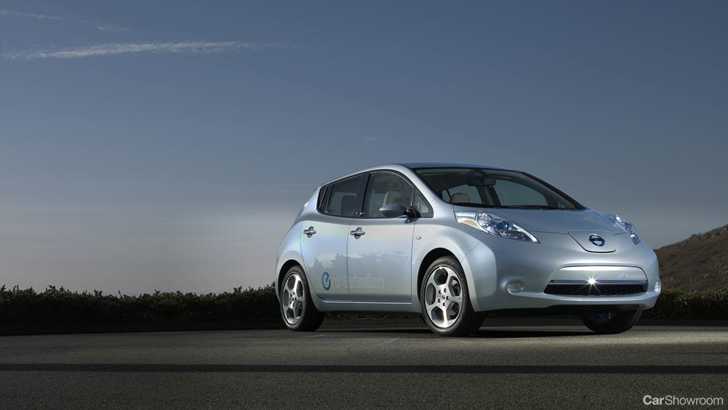
Elsewhere in the LEAF interior are numerous ‘eco driving’ gauges familiar to drivers of hybrid vehicles. We liked the drive mode selector which resembles a current-generation computer mouse – very ergonomic.
And all LEAFs sold in Australia will feature a standard satellite navigation screen. The two LEAFs in Australia now are European specification vehicles and their current sat-navs display the city of London with a highlighted section showing how far you can go on your current battery charge and where the nearest re-charging stations are – a feature Nissan hopes to include in Australian LEAFs.
Interior space is comparable with normal hatchbacks, albeit with the rear seat slightly raised ‘theatre-style’ to accommodate the battery packs mounted underneath. Nissan says this central, low mounting of the 250kgs packs contributes to impressively sporty ride and handling (some rival vehicles have their heavy electronics sitting high-up and /or to the side of the vehicle).
In another twist to the current generation, each Nissan LEAF will have its own SIM card enabling owners to join a global data base (managed by Nissan) and use their computer or i-Phone app to (for example) remotely monitor the progress of their battery charging or turn-on the climate control system – from anywhere in the world (but usually while in the office, shopping mall etc).
Externally the Nissan LEAF looks like an extremely aerodynamic hatchback – and basically that’s what it is. Electric cars rely on good aerodynamics not only to reduce drag for maximum range, but also for noise suppression as the lack of engine noise exaggerates every other sound.
For example, the large, raised headlights of the LEAF aren’t a styling eccentricity – they’re shaped to direct airflow over the exterior mirrors in order to reduce their buffeting and noise.
With no radiator requiring cooling air, or internal combustion engine to hide, the LEAF’s front-end slopes steeply and produces a pronounced, aerodynamic ‘bubble’ reminiscent of Japan’s bullet trains. Similar story at the side with deep contours to direct airflow, while naturally the rear has a roof spoiler.
LEAF doesn’t share its platform with Nissan’s Tiida, instead using a unique chassis (to accommodate the centrally-mounted battery pack). There’s also substantial aerodynamics underneath with a large, flat cover to direct air.
By any measure our first acquaintance with the Nissan LEAF left a good impression and Nissan Australia CEO, Dan Thompson makes no bones about the Japanese giant’s desire to be the global EV leader. The Nissan-Renault alliance has so far invested $US5-billion in developing eight EV vehicles across three brands (Nissan, Infiniti and Renault) – and that’s just the start.
But don’t forget this is an alliance run by the enigmatic Carlos Ghosn, so EVs have to stand-up alone as a business case. Pricing for the LEAF in North America starts at $32,500, but Mr Thompson would not be drawn on likely Australian pricing.
“We’ll talk about that closer to launch, but EVs are a business unit for Nissan and we expect them to be profitable for us and our dealers,” he told Car Showroom.
Nissan’s EV leader Michael Hayes expects initially Nissan Australia will market the LEAF via selected specialist dealers. “The (Nissan) GT-R business model is what we’re looking at, with specialist trained dealers who can sell and service the LEAF,” he told Car Showroom.
Make no mistake though, Nissan with the LEAF, Mitsubishi with the i-MIEV and Holden with the Volt - plus the Canberra-based Federal Chamber of Automotive Industries and recharging providers like ChargePoint and Better Place - are the pioneers in the Australian electric car market…but there will be a cue of other manufacturers forming soon.


