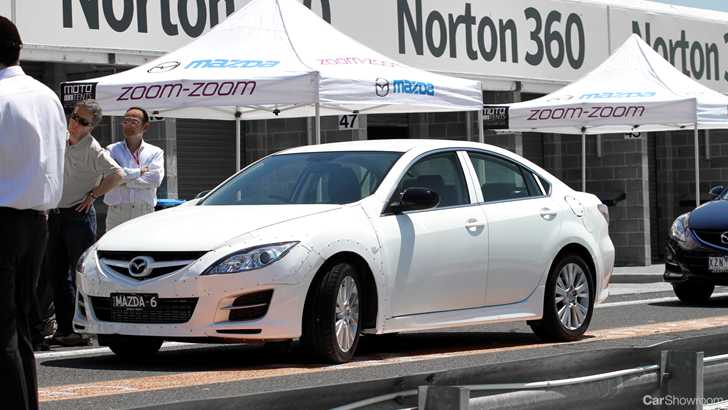
Mazda has allowed Car Showroom to drive the multi-million dollar prototype Mazda6 fitted with its ground-breaking Skyactiv technology.
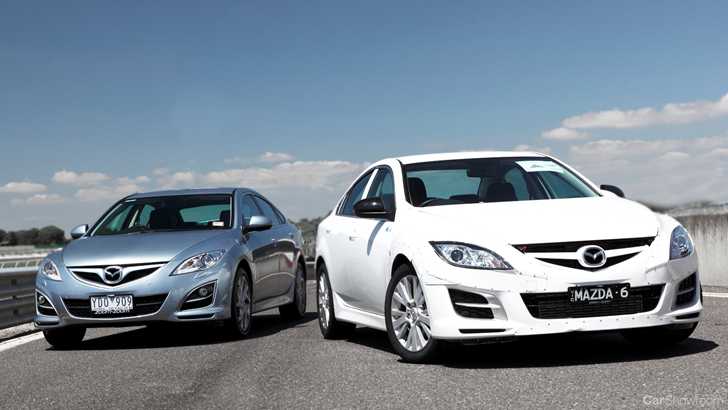
Our drive in the modified German Mazda6 took place in controlled circumstances at Melbourne’s Sandown Raceway, but back-to-back runs allowed direct comparisons to the current Mazda6.
Under the bonnet, the prototype vehicle featured Mazda’s SKYACTIV-D four-cylinder turbo-diesel engine. Mazda has thrown out the rule book in developing this powerful, fuel efficient diesel – the Japanese giant went for a low compression ratio (14.0:1 – the world’s lowest) design with a two-stage turbocharger.
According to Mr Susumu Niinai, Mazda’s engine boss, this configuration (with suitable internals like specially-developed pistons and conrods) enables Mazda diesels to exceed the demands of upcoming exhaust gas regulations like EU6 without the need for expensive exhaust after-treatments.
Mazda reckons its SKYACTIVE-D uses up to 20 per cent less fuel than its current 2.2-litre diesel, delivers more torque – especially in the most-used low to mid-range - and performs better when cold.
There’s also a SKYACTIVE-G four-cylinder petrol engine with the world’s highest production car compression ratio of 14:1, special pistons and the rest, plus a 4-2-1 exhaust manifold which delivers 15 per cent better fuel economy.
The prototype Mazda6 also ran Mazda’s SKYACTIV-Drive six-speed automatic transmission which, in delivering improved fuel consumption in the range of 4.0 – 7.0-percent, provides rapid shifting with better feel (there’s also a manual version). Mazda says it’s expanded lock-up range and mechatronic module combine the best of conventional ‘Step’ automatics, CVTs and dual-clutch autos.
Underneath was Mazda’s SKYACTIV-Chassis – again an innovative configuration of links and geometry, 6.4kgs lighter in the front and 5.4 kgs lighter in the rear. There’s 7.0 degrees of front castor and more toe-in at the rear, where a reduction in the vertical load delivers more slip angle and 10 per cent more grip.
Overall Mazda says the SKYACTIV suspension is 14 per cent lighter than the current Mazda6.
What does all that mean on-road?
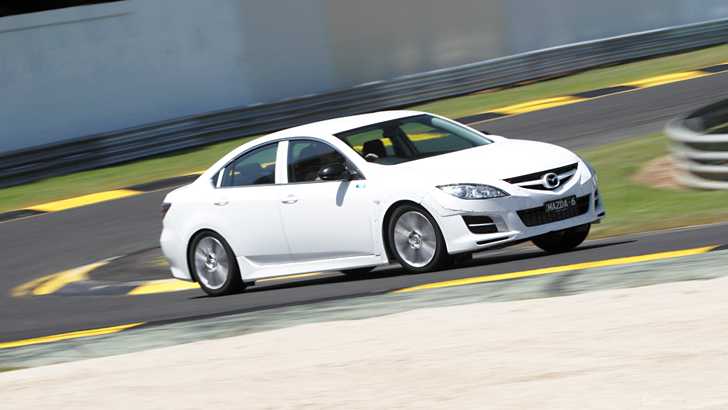
Well hard laps around Sandown Raceway obviously could not quantify gains in fuel consumption, but there’s no doubt about the extra performance of the Mazda SKYACTIV-D diesel – much stronger mid-range torque provided significantly faster acceleration and a much higher top speed at the top of Sandown’s back straight (around 200km/h to be precise).
The SKYACTIV-Drive automatic was certainly much crisper in its cog-swapping than Mazda’s current auto. We liked the precise downchanges – perhaps not quite as sharp as a DSG, but Mazda says its transmission is much smoother at low speeds around town where the German DSGs can be a tad ‘clunky’.
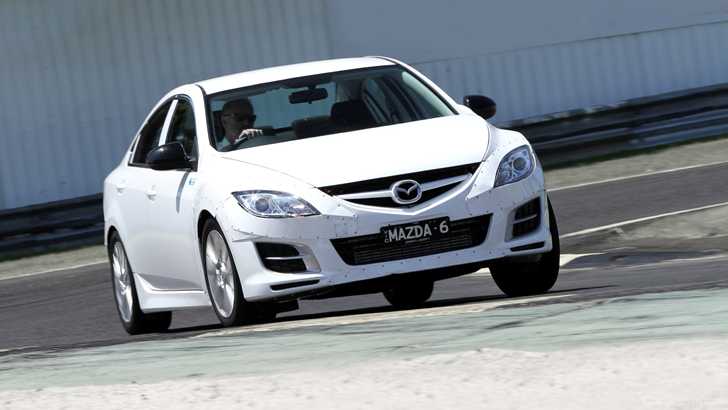
Equally impressive was the high-speed handling resulting from the SKYACTIVE-Chassis. Turn-in compared to the standard Mazda6s we drove back-to-back was sharper, without any signs of destabilization from the rear end and the rebound performance of the struts over Sandown’s kerbs was noticeably improved.
A by-product of the better performance/reduced fuel consumption/lighter weight included in all this SKYACTIV technology is supplemental electrical systems can be smaller and lighter as well (they don’t need to work so hard) – another gain.
Mazda says SKYACTIV is all about providing gains in fuel consumption and reductions in exhaust emissions by as much as 30 per cent across its entire range while maintaining its hallmark ‘Zoom Zoom’ driving dynamics. Smart thinking because Mazda predicts by the end of this decade, electric vehicles will still account for only five percent of global sales, with internal combustion engines still the dominant power source.
Of course Mazda has already announced a joint venture with Toyota for Hybrid power vehicles and separately is working with electric vehicles, but right here, right now, there is no better alternative than to enhance the performance of its petrol and diesel driven powertrains.
As Mazda’s Kiyoshi Fujiwara, the global head of product planning and powertrain development, told Car Showroom: “SKYACTIVE might not be as glamorous or spectacular to unveil as a new Electric Vehicle or Hybrid, but it fits Mazda’s ‘Zoom Zoom’ philosophy and, as you’ve seen driving this car today, still delivers massive improvements which we can introduce while we progressively develop other initiatives like hybrids and regenerative braking.”
Perhaps best of all, for new car buyers, Mazda says a crucial consideration in developing this ground-breaking technology was to keep manufacturing costs down. Mr Fujiwara told us already Mazda6 SKYACTIV is no more expensive to make than the current Mazda6.


