Hyundai Deserves World Rally Championship ‘Man Of The Match’
If there was a ‘Man Of The Match Award’ in the 2014 World Rally Championship (WRC), ink-in Hyundai as a deserving winner.
Just 18 months after commissioning a blank sheet of paper project based in Frankfurt, Germany it was fitting that the Hyundai scored a historic 1-2 in last month’s Rallye Deutschland – effectively the team’s home event.
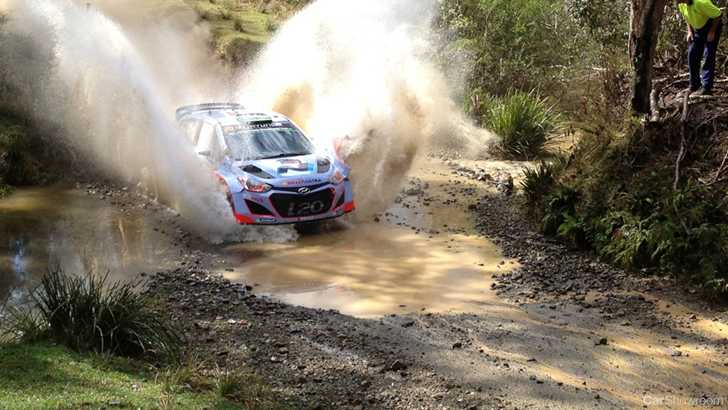
Ironic too that Hyundai’s first WRC victory came in the home event for the championship-winning Volkswagen team.
With the Manufacturers Championship now already secure with Volkswagen for a second consecutive year, Hyundai is battling against the French Citroen team for second place honours.
Aussie Chris Atkinson has been part of the Hyundai squad – albeit with limited seat time. Prior to last weekend’s Rally Australia, Atkinson’s previous event was Rally Guanajuato Mexico in March and limited time behind the wheel has restricted his performances.
Hyundai Australia is pushing hard behind the scenes to secure Atkinson’s future in the team and hasn’t ruled-out backing the talented Gold Coast drivers with some sponsorship dollars.
So why, with the myriad of choices available to it, did Hyundai elect to take-on Volkswagen, Citroen and Ford in the WRC?
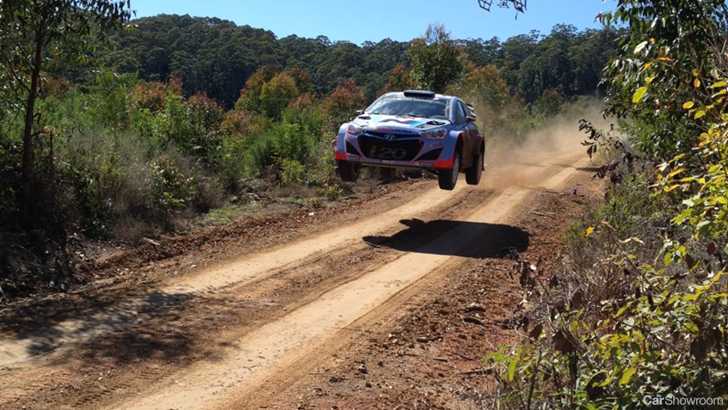
“Because it’s good for the brand,” explained Hyundai WRC Team PR chief Thomas Villette (a Frenchman who arrived at Hyundai Motorsport from the Peugeot sports car team by way of the Toyota F1 team).
Like the rest of the WRC squad, Villette is employed by Hyundai Motor Europe – this is a full-on factory team based in Frankfurt, Germany within 50kms of Hyundai Motor Europe’s base in Offenbach and the technical and design centre in Russelsheim.
“It’s a logical next step for Hyundai and unlike other major sponsorships we’ve done (think football World Cup), this one showcases our product,” revealed Hyundai Australia PR chief Bill Thomas.
With Rally Australia (Coffs Harbour, NSW), the 10th round of the championship, Hyundai Australia scored a massive ‘free kick’ with the arrival of the ultra-slick F1-like WRC team with three WRC cars, a handful of specially-prepped reconnaissance cars and four shipping containers containing 50 tonnes of tools, spare parts, a mobile office and workshop plus service area equipment and structures.
Multiply that by three with the addition of Volkswagen, Ford and Citroen plus the teams contesting the WRC2 championship and the ‘Service Park’ in Coffs Harbour – like the other 12 rounds in the championship - looked straight from F1.
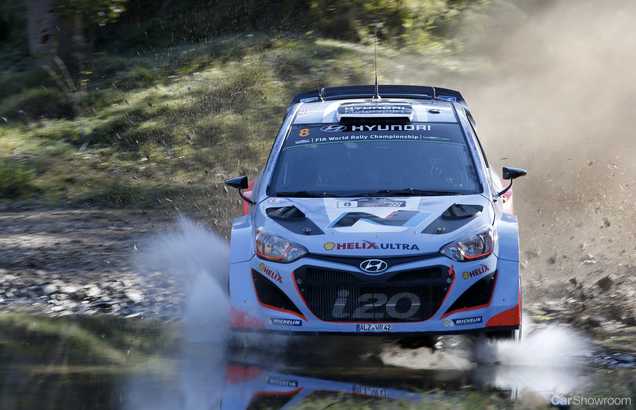
And - also like the rest of the Service Park - the Hyundai team is a ‘League Of Nations’ with employees from 24 countries included in its 100-strong work-force (60 travelled to Australia).
While 10 of the 13 championship events are in Europe (Australia, Mexico and Argentina are the ‘fly-aways’), according to Vilette, Hyundai’s massive effort in the WRC is not just about brand building in Europe.
“The WRC has fans globally, the television audience is large and so, for us, this is about brand image in all markets,” he said.
Your www.carshowroom.com.au correspondent has covered all forms of motorsport, including F1, for decades and after spending the Rally Australia weekend in Coffs Harbour with the Hyundai WRC team we were astonished by the professional F1-style set-up in the Service park (imagine the F1 or V8 Supercar paddock set-up in a small country town – brilliant!) and the well-drilled way the technicians went about their work in the time-restricted breaks between stages.
It seems the rest of the WRC world is similarly impressed by Hyundai - particularly after the team’s 1-2 result last month in Rallye Deutschland – barely 18 months since the team moved into their 8,200 square-metre complex in Alzenau to commence operations.
To put Hyundai’s WRC success into perspective: while Volkswagen wrapped-up its second consecutive WRC in Coffs Harbour that really is the culmination of a four year program for the Polo WRCs which came on the back of the Skoda team which ran Fabias (essentially the same car as the Polo WRC) back in 2012 alongside a massive testing program for the actual Polo WRCs.
So for Hyundai to be so successful so quickly is real compliment to the team headed by Michel Nandan who has the built the team from scratch.
Base car is the European specification Hyundai i20. Essentially though we’re talking the body-in-white shell which is fitted with appropriate carbon-fibre bodywork but does include standard headlights and tail-lights.
Inside is a complex cave-like structure with the right-hand seat for the navigator set low (for safety), a cockpit-like set-up for the drivers’ seat, pedal box and steering wheel, lots of electronic management system boxes, storage for spare wheels, jacks and tools plus the all-enveloping roll cage.
Power comes from a turbocharged, direct injection 1.6-litre engine delivering 224kW of power at 6000rpm and peak torque of 400Nm at 5000rpm (WRC cars are fitted with a mandatory 33mm air restrictor).
Drive is to all four wheels (mechanical front and rear differentials) via a six-speed sequential racing transmission.
For Rally Australia the gearing was configured to give a top speed of around 180km/h (that’s very, very fast on dirt forest roads!)
Ventilated 300mm Brembo brakes handle the stopping and a hydraulic quick-action handbrake is used to slide around hairpin bends.
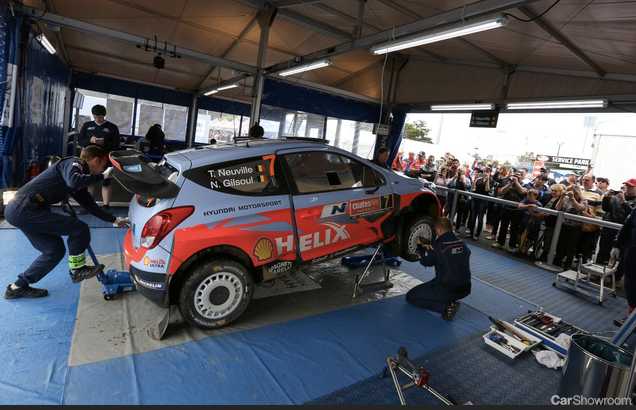
Tyres are supplied by Michelin (LTX Force) and each car can use a maximum of 24 tyres for the Australian leg of the Rally.
Unlike any other form of motorsport, at refuelling stops (done out on the road) drivers and navigators work on the cars themselves, usually swapping tyres front to rear or changing them.
In Rally Australia, on day two we found Hyundai team driver Chris Atkinson and the rest of the WRC field parked by the side of the road in the tiny township of Bowraville changing tyres – in Atkinson’s case a real necessity as he’d fitted the soft compound S4 tyres and after Special Stages 9 and 11, they were shot.
Earlier this year in Mexico, Hyundai WRC lead driver Thierry Neuville stopped at the end of the final stage and used a bottle of Corona beer presented to him for refreshment to top-up a damaged radiator in his i20 WRC to get him back to the Service Park…don’t see that in F1 (or any other form of international motorsport).
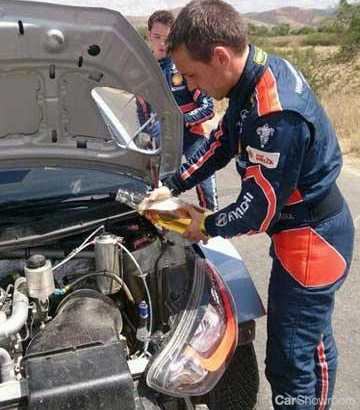
With three rounds to go in the 2014 championship, Hyundai Motorsport is already developing a new i20 WRC for next year and that’s not without its challenges in a sport which uses road-going bodyshells as the base car.
Villette says the new car will incorporate engine and suspension changes as well as a new look.
Australian rally fans are hoping the talented Atkinson will be part of the team and Hyundai Australia is doing everything possible to ensure he is.


