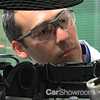
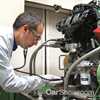
Think you've got super-hearing? These guys get paid to listen to running engines, and if they find fault, the powerplants get binned.


Believe it or not, there are some people working at Ford whose job description reads more or less as ‘Engine Listener’ for the Focus RS hot hatch. We kid you not, and besides April fools was a full four days ago.
Ford seems to put a lot of faith in the small human touches, at least in this case, as a thin finishing layer over what is arguably rather coldly efficient and precise manufacturing process.


What these individuals do using their highly-specific set of skills is enter a special soundproof cell with the engine in question - a 2.3-litre turbocharged 4-cylinder that produces 261kW – and carefully listen for the tiniest hint of an engine issue as part of the rigorous quality tests that go into their new Focus RS.
We imagine that such high quality standards will also apply, perhaps even to a more extreme degree, to the 3.5-litre turbocharged V6 they’re slotting into the new Ford GT.

Ford has concluded that for certain tests no complex array of fault-sensing machinery can match the intelligence of the human brain paired with a pair of ears to ensure the RS’ engine is performing at its absolute best. After the engine get’s the all-clear from the highly trained production workers with the million-dollar ears, it gets installed in the car and the rest of the production can carry on.
“This team knows what a perfectly calibrated engine sounds like and they know the tiny sounds to listen for in case there is a problem,” said Gunnar Herrmann, vice president, Quality, Ford of Europe. “Think of it like a doctor who has the most advanced diagnostic technology but still uses a stethoscope to gather vital clues to a patient’s health.”
Selected employees at Ford’s manufacturing plant in Valencia, Spain are trained using specially prepared ‘faulty’ engines for several months before being deemed qualified to enter the chamber of silence with a real production engine.


Other cars to receive this special brand of quality control include the Focus ST, S-Max, and Mondeo, with the squad of testers routinely carrying out aural tests on 2,000 engines per day.
“The experience of hearing thousands of engines allows us to sense straight away when something is not working perfectly,” said Juan Carlos Rosmari, quality technician, Valencia Engine Plant. “Each different engine type has its own unique sound, and from listening to them in the test cells we get to know their individual characters – and the tell-tale signs which indicate a problem.”