Based on yesterday’s Australian Grand Prix it seems the new technical regulations for F1 racing have failed the major test - that would be the part called ‘racing’.
Yesterday’s 58-lap race capped a weekend for F1’s all-new 1.6-litre V6 engines with ERS-K and ERS-H energy recovery systems which, to be honest, wasn’t the sport’s best effort (and your Carshowroom.com.au correspondent has been in/reporting on F1 since 1977).
The massive technical changes – not only the engines but also the eight-speed transmission, reduced nose height, simplified rear wing and smaller front wing – proved too much for the teams and their various technical suppliers to hone with the mandated maximum of 12 pre-season testing days.
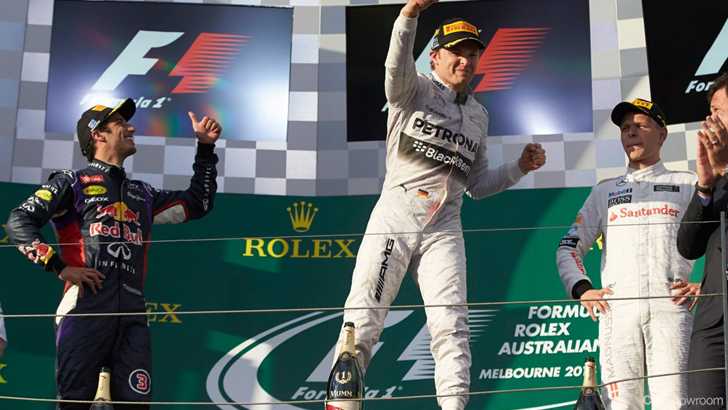
The result was a processional race won by Mercedes-Benz driver Nico Rosberg, ahead of Australian Red Bull-Renault driver Daniel Ricciardo and Dane Kevin Magnusson in his McLaren-Mercedes.
Then at 8:30pm, the F1 paddock at Melbourne’s Albert Park was thrown into chaos again with news the FIA race stewards has disqualified Ricciardo’s Red Bull Renault as the engine was found to have exceeded the new-for-2014 maximum fuel flow rate of 100kg/hour (motor sport uses weight to measure fuel capacity as it is immune to changes in temperature and air pressure).
Next, as usual in F1, the recriminations and technical critiques started with the Red Bull team claiming it reverted to using its own fuel flow sensor as there had been: “inconsistencies with the FIA fuel flow meter all weekend up and down the pitlane”.
So Red Bull is appealing the Ricciardo’s disqualification and so it should. Indeed the FIA should be thankful the team and engine supplier Renault worked around the clock since the final pre-season test in Bahrain to at least provide some competition to the dominant Mercedes-Benz powered teams.
Had Red Bull and the other teams been allowed to test for more than 12 days before the first race, the fuel flow meter problems would probably have been solved before last weekend (indeed the Lotus team may have been able to get their cars completed and avoided the farcical scenes of Friday’s first free practice in Melbourne when neither Lotus took to the track and technicians were seen frantically affixing sponsors logos to the bodywork in full glare of the world’s media).
Of course the driveline changes (hybrid engines and eight-speed transmissions) are all about making F1 more relevant to future, more energy-efficient road car technology. In fact the 2014 F1 cars new power units are so efficient in energy recovery, the electrics provide a power boost of up to 120kW for almost 30 seconds per lap.
Unfortunately a by-product of that is engine noise and, with their new-for-2014 single exhaust pipe above the gearbox (and no ‘blown’ rear diffusers), the F1 cars sounded at best ‘anemic’ around Albert Park or worse “like a sewing machine on wheels” as one V8 Supercar driver suggested via Twitter. Indeed the Porsche Carrera Cup racers at Albert Park produced more Dbs that the F1 cars and, for the first time in living memory, you could easily hold a conversation with someone in the F1 paddock – while the F1 cars were racing!
Good points from Albert Park? Well, aided by those ‘Benz engines, the McLaren and Williams teams are back with genuine claims to win a race this year (indeed McLaren leads the Constructors Championship after Melbourne with second-generation racer Magnusson followed across the line by his British team-mate Jenson Button).
But even the front-running Mercedes-Benz and Red Bull teams aren’t immune to the problems with both Lewis Hamilton and reigning world champion Sebastien Vettel sidelined early yesterday by engine problems.
And, it must be said with the extra torque and reduced downforce, the new F1 cars are twitchy (power oversteer is back!) which makes for great entertainment for the crowd and should mean there will be some decent racing and overtaking when the myriad of technical changes are nailed-down.
So much to do, so much pressure, so little time – the F1 technicians will be getting little sleep and won’t be home much for the foreseeable future…again.


