Japan’s fickle autumn weather has written another controversial chapter in F1 history (remember James Hunt’s 1976 World Championship win came amongst amidst flooding rain and darkness at the Mt Fuji circuit).
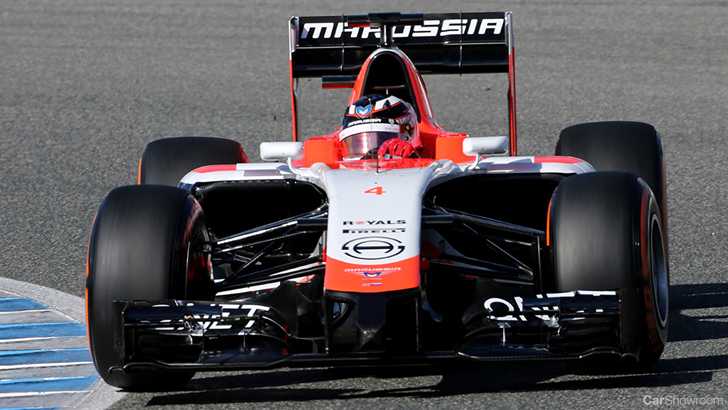
Like many www.carshowroom.com.au readers we’ve seen the shocking amateur video from Sunday’s race which shows the Marussia driven by Jules Bianchi slamming into a tractor on lap 44 of Sunday’s race at the Honda-owned Suzuka circuit 50kms south of Nagoya .
As we write the 25 year-old French driver lies in a coma in a critical condition in the Mie General Medical Centre with his parents, agent Nicolas Todt and the president of the FIA’s medical commission Gerard Salliart (who also treated Michael Schumacher following his skiing accident) by his bedside.

The tractor was trying to remove the Sauber of Adrian Sutil which had also crashed at Suzuka’s Turn 7 as heavy pre-typhoon rain lashed the race circuit.
A global outcry has erupted with many, including former World Champion Niki Lauda, asking why – given the forecasted arrival of the typhoon conditions – the race start wasn’t pulled forward by several hours.
Global television scheduling is the answer – the Japanese Grand Prix always starts late to suit European TV timing – and F1 has to fit in with other sports to get its share of the audience.
And we’ve been told the weather at Suzuka last Sunday was changeable with rain in the morning, then a brief dry spell (but not enough to hold the F1 race in its entirety) followed by the rain which we saw when the F1 cars were on the grid and which led to the Japanese Grand Prix staring behind a safety car.
The complicated F1 point-scoring system required 40 laps of the Japanese Grand Prix to be completed before full point could be allocated and in fact drying conditions throughout the race saw most of it contested with the cars on intermediate rather than extreme wet weather tyres.
The bigger question we think is why, with conditions abruptly turning worse - and aided by massive satellite meteorology which the FIA, circuit administrators and even the teams have available to them – wasn’t the race red-flagged the second race-winner Lewis Hamilton drove his Mercedes-Benz across the start-finish line to complete 40 laps.
And clearly the race should have been red-flagged when Sutil crashed and before the tractor emerged from behind the carrier to remove his Sauber.
The footage of Bianchi’s crash shows his out-of-control Marussia hitting the tractor at incredible speed so we also think the FIA needs to address speeds of F1 cars in waved double yellow flag sectors of the circuit.
The problem is F1 cars require speed to maintain the downforce which keeps them glued to the road – but double yellow flags, unlike single yellow flags, are meant to be used when there is extreme danger in that section of the circuit so maybe it’s time the sport mandates a suitable speed (which the drivers could set using the same speed-limit system used in pit-lane).
Changes are needed – what do you think?


