We’re only days away from the official unveil of the all-new seventh-generation BMW 5 Series. Bestowed with the internal designation G30, the new 5er will be - by all indications - an evolutionary step over the current F10.
Under that seemingly familiar skin, though, we’re told that the plethora of individually minor changes amount to a potential class-leader for the Munich-based automaker, with the new Mercedes-Benz W213 E-Class and Audi A6 firmly in its crosshairs once again.
This time, it also gains the multi-material construction expertise BMW gained from the i3 and i8, in which carbon fibre reinforced polymer (CFRP) are used to reduce weight while increasing safety and torsional rigidity. A clear example would be the sixth-generation 7 Series (G11).
A sophisticated high-resolution digital instrument cluster is also slated to make an appearance in the upcoming 5 Series, which is an evolution of BMW’s lauded iDrive system that will rival competitor offerings such as Audi’s Virtual Cockpit and Mercedes-Benz’ Comand Online.
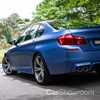
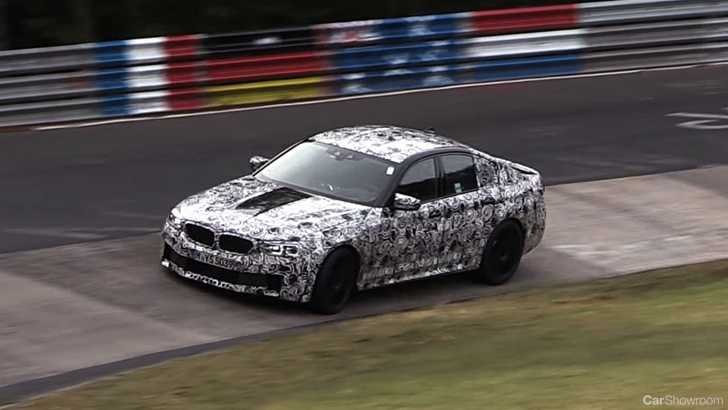
BMW’s M Division, though, has been hard at work perfecting the G30’s high-performance variant (F90). The pressure is on to surpass its well-regarded predecessor. Where that iteration brought about a controversial change in the M5 formula in forced induction (it’s 4.4-litre V8 features twin-turbochargers), this upcoming generation will sidestep rear-wheel drive in favour of a rear-biased all-wheel drive system.
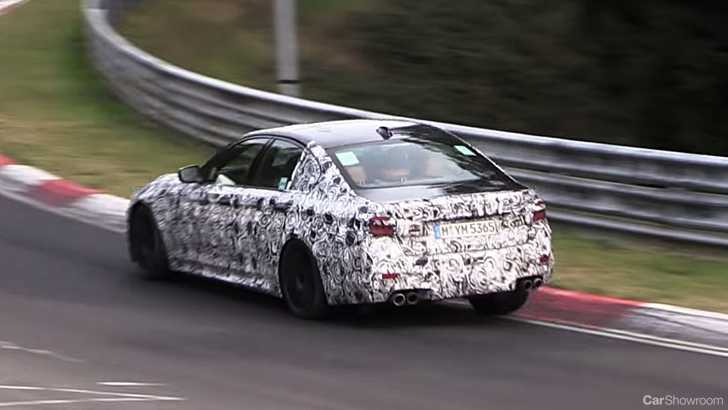
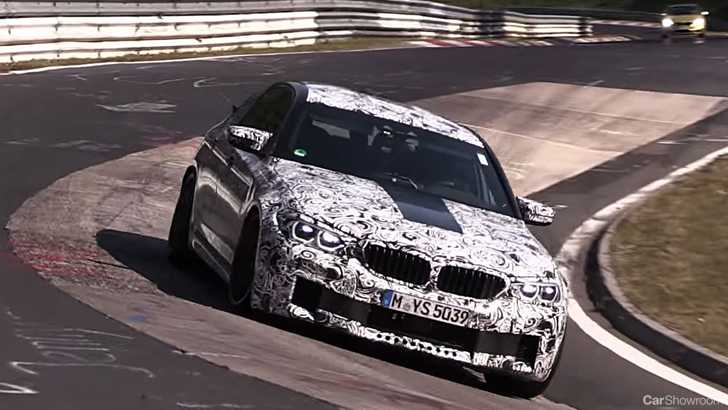
While testing on the Nurburgring, the new M5 test car looks to be unusually composed, taking more liberty with corner entry speed and powering out away from the apex. BMW would definitely want to keep as much of its rear-wheel drive sensibilities its cars are so known for, but with all-wheel drive to pick up the slack where more grip can be gained through the front tyres.
The same S63 eight-cylinder engine remains, however, is evidenced by that burbly soundtrack, and the F90 looks to have kept the Getrag-sourced 7-speed dual-clutch transmission. Engine power and shift times and refinement are all bound to have been improved, though.
Some have pointed to the revised powertrain to now develop in excess of 447kW, a substantial increase over the F10 M5’s 417kW. Torque, however, could remain within the same range as the older car’s 680Nm. And with all-wheel drive helping to transmit every iota of extra power to the road, the F90 M5 should see a significant improvement over the F10’s 4.4 second 0-100km/h sprint time.
For more on BMW vehicles, including pricing and specifications, check out our Showroom.